
Davidson Projected Versus Actual Release
A projected date is a calculation or milestone. An actual release date records when a custodian ended one custody episode. For a TDOC prisoner, FOIL may show a Release Eligibility Date as the earliest point at which parole consideration is allowed. It can also show sentence expiration or other release information. Eligibility is not an appointment to leave. A Board denial, pre-release condition, disciplinary action, another sentence, or detainer can keep the person in custody.
A pretrial DCSO detainee often has no sentence-based date. Bond, recognizance, a hearing, dismissal, or another court order may change custody, but none can be calculated from admission alone. A locally sentenced person may have a DCSO computation. A state prisoner has a TDOC sentence calculation. Mixing those paths produces false precision.
Find a Davidson Projected Date
First identify the custodian. A DCSO control number points to county custody. A TOMIS number points to TDOC custody or supervision. The official FOIL gateway covers felony offenders now or formerly in TDOC custody or supervision, but not every Davidson misdemeanor booking. DCSO records and the court file control a local sentence.
- Obtain the judgment and offense date. Identify each sentence, range, alignment, and jail credit.
- For a state prisoner, search FOIL by TOMIS number or name and open the matching detail.
- Record the exact labels for status, Release Eligibility Date, Sentence End Date, hearing data, and release data.
- For local confinement, ask DCSO for the sentence computation and release record, then compare the judgment.
- Check parole action, holds, consecutive cases, and the date on which the online record was viewed.
- Request the formal sentence record when a dependable document is needed.
The Davidson release-record search path reconciles DCSO, the clerk, and a receiving agency. A live roster can identify current custody. It is not a historical release-date source after the person leaves.
Tennessee Release Credit Rules
Tennessee has no single release percentage. Under Tennessee Code section 40-35-501, eligibility can depend on offense date, offense, sentencing range, sentence length, consecutive terms, and statutory exclusions. Traditional range rules use different percentages for especially mitigated, standard, multiple, and persistent offenders. Those percentages establish eligibility points where the governing subsection applies. They do not promise release.
Section 41-21-236 governs sentence-reduction credits for eligible state prisoners. Within statutory limits, awards can range from one through sixteen days per participation month, with portions tied to institutional conduct and program performance. Credits can be lost or not retained. Their legal effect varies by sentence and offense date. Limits on how far credits can advance earliest eligibility also apply. Subtracting the maximum credit from a sentence will not produce an official Davidson release date.
Tennessee 85 Percent Limits
The often-repeated “85 percent rule” applies only to specified offenses and date ranges. Section 40-35-501 includes aggravated robbery and other listed offenses under particular provisions. Some earlier versions allow credits to reduce a served percentage only to a stated floor. For listed offenses committed on or after July 1, 2024, an applicable subsection may require an 85 percent eligibility calculation without reduction while allowing credits for another purpose.
Other offenses require full service or provide no parole eligibility. Amendments can change how credits affect eligibility and sentence expiration. The offense date is essential because the law in force for one judgment may not control another. The claim that every Tennessee inmate serves 85 percent is wrong. Life without parole and other exclusions must never be portrayed as a projected community release.
Why Davidson Release Dates Change
TDOC policy requires staff to compare sentencing documents with the offender system, check judgments, revocations, detainers, and unprocessed-sentence flags, obtain sentence-services confirmation, and complete an authorized release checklist. The public field is useful. The completed agency record is the audit trail.
| Change | Possible effect | Record |
|---|---|---|
| Corrected judgment or jail credit | Recalculates time owed | Court and computation |
| Credits earned or lost | May move eligibility | TDOC sentence record |
| Disciplinary deferral | Can delay eligibility | TDOC record |
| Parole denial or deferral | Custody continues | Board result and FOIL |
| Detainer or new case | May cause transfer | Movement record and court |
| Administrative correction | Changes an online field | Official computation |
Note: Preserve the field label and “last checked” date because FOIL data can change after lawful review.
Davidson County Sentence Computations
Local misdemeanor confinement has another statutory layer. Section 41-21-236(f) provides a credit framework for qualifying people in a county jail, workhouse, or local facility. The court fixes a release percentage within the lawful range, and credits cannot reduce it beyond the statutory limit. A facility may use another lawful elected rate. Those rules still do not reveal DCSO's computation for one person.
DCSO does not publish a local calculator or a good-time policy detailed enough to calculate an exit from the admitted date. Request the existing computation, judgment-linked jail credit, and release record. A resident at the Offender Reentry Center remains in custody during approved outside work. That movement does not equal discharge.
Davidson Release Date Channels
No single channel answers every Davidson date question. FOIL is the state felony path. DCSO and the Criminal Court Clerk cover county custody and judgments. The Board supplies parole decisions. VINE supplies agency-fed custody-change notices, not sentence calculations. BOP controls federal locator dates, while ICE and the federal docket may be needed after a transfer.
Use FOIL status literally. Incarcerated means current TDOC custody even if a future date appears. Parole means community release under state supervision. Probation is court-ordered community supervision. Inactive is a former-offender status that needs sentence and release fields for context. County-only cases may never appear.
The official state image below documents the channel. Review the FOIL scope statement before searching.
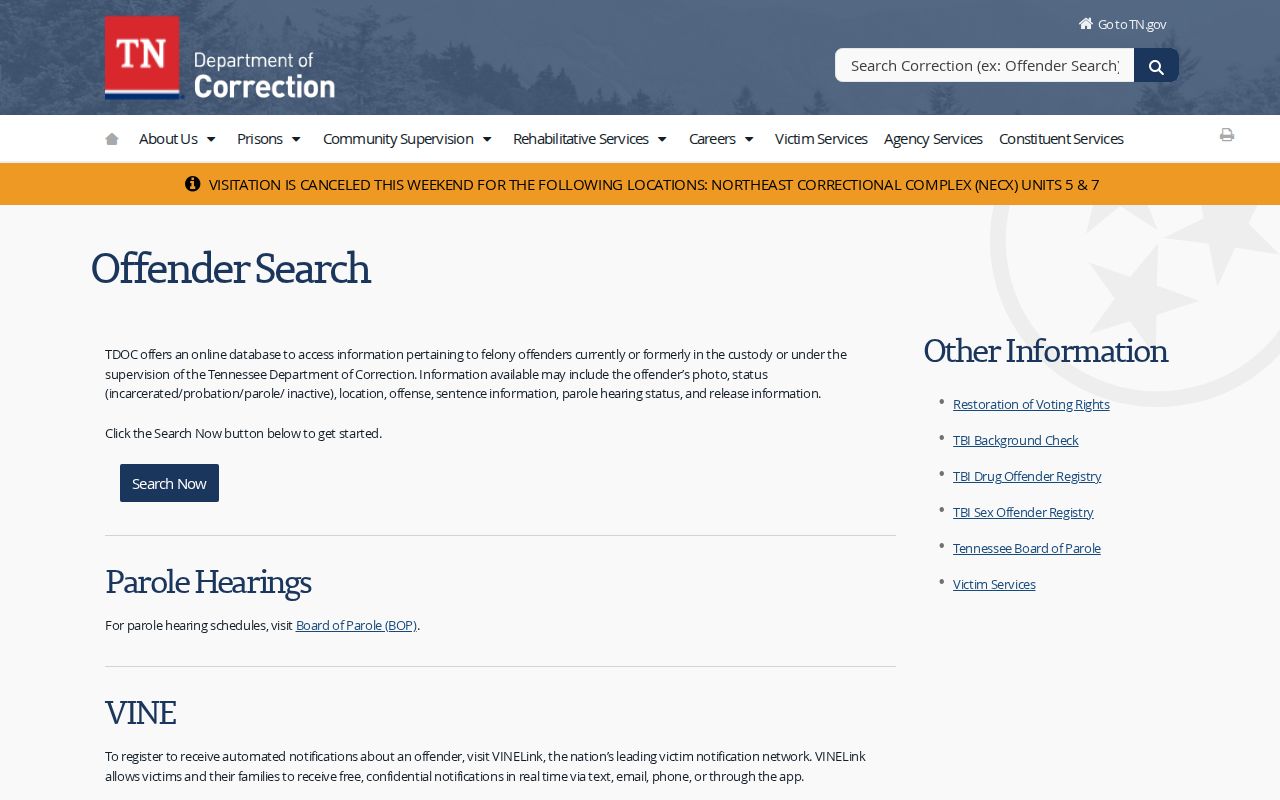
The gateway fits a TDOC sentence, not a short DCSO-only stay. A missing result should return the search to DCSO and the court.
Confirm Davidson Actual Release
Close the search with the custodian. For DCSO, ask whether the entry was community release or transfer. For TDOC, compare the Board result, FOIL status, and final authorization. For a federal or immigration handoff, use the receiving locator and court or agency record. A projected date can pass while custody continues.
VINE can provide an alert after the reporting agency updates its status. It still describes release from that custodian. It does not rule out supervision, another sentence, or transfer. The safest conclusion remains narrow: the named office recorded the stated date or status.
Davidson FOIL Release Date Fields
FOIL may include an offender photo, current status, location, offenses, sentence data, parole-hearing data, and release information. Search by TOMIS number when possible. The direct interface also supports SID and TDOC identifiers. A name search can use aliases and narrowing fields, but identity should rest on more than one match.
| Field | Meaning | Limit |
|---|---|---|
| Status | State custody or supervision relationship | Not a county-only release record |
| Release Eligibility Date | Earliest statutory parole milestone | Not guaranteed release |
| Sentence End Date | Computed sentence expiration | Read with all active sentences |
| Parole Hearing Result | Board action shown for the person | A grant may require later steps |
If a field seems inconsistent, FOIL is informational. TDOC’s archived-record process can provide the release authorization, computation, or movement history. A technical support contact cannot certify sentence history.
Parole and Davidson Release Dates
The Tennessee Board of Parole controls parole decisions. Eligibility merely permits consideration. A hearing can produce a grant, denial, deferral, or other action. Even a grant can carry pre-parole conditions and depend on an approved plan. FOIL and a later custodian update close the gap between Board action and physical release.
Mandatory reentry supervision under section 40-35-506 adds another distinction. A person can leave prison near sentence expiration yet enter a required period of service-oriented supervision. A projected prison exit therefore does not always equal discharge from all state control.
For an archived computation, TDOC asks for the full offender name, TOMIS number, birth date, and a clear description of the desired record. It advises requesters not to send payment first because archive charges, if any, are quoted after the search. A request can name the final release authorization, sentence computation, movement entry, and supervision status.
Tennessee Release Eligibility Ranges
Traditional Tennessee range rules illustrate why a sentence length alone cannot yield a date. Section 40-35-501 includes eligibility points such as 20 or 30 percent for especially mitigated offenders, 30 percent for Range I standard offenders, 35 percent for Range II multiple offenders, and 45 percent for Range III persistent offenders where those provisions govern. Eligible retained credits can affect the calculation only as the applicable subsection permits.
These figures are eligibility fractions, not release promises. The offense date, range classification, judgment, consecutive alignment, statutory exclusions, and each sentence must be checked first. A person can reach the calculated point and remain incarcerated after a Board denial or deferral. Another sentence can also extend the controlling date beyond the first case.
Davidson Sentence Credit Limits
Section 41-21-236 does more than authorize monthly credits. Subsection (i) limits how far credits can move the earliest eligibility point. The research identifies a general ceiling of 35 percent and, for offenses on or after January 1, 1988, a ceiling of 30 percent. A ceiling is not an award. The warden’s action, conduct, program performance, review, and any credit loss determine what is actually retained.
For offenses before July 1, 2024, and for certain sentences under two years tied to later offenses, credits may reduce the sentence as the governing law allows. For a sentence over two years based on an offense on or after that date, credits may affect parole eligibility without changing sentence expiration. This distinction explains why FOIL can show both a Release Eligibility Date and a separate Sentence End Date.
Verify Davidson Sentence Calculations
TDOC Policy 511.03 describes release controls behind the public date. Staff compare judgments with the offender-management system, check revocations, detainers, and unprocessed-sentence flags, obtain Sentence Information Services confirmation, and complete an authorized release checklist. Those safeguards can reveal an issue that the public-facing date does not yet reflect.
For a Davidson County jail sentence, request the existing DCSO computation because no public local calculator supplies the needed policy and judgment data. For a TDOC sentence, request the official calculation or archived release authorization. In both systems, identify the person and episode precisely and ask for the record as it exists rather than requesting a new estimate.