
Davidson 72 Hour Release Source
No separate official DCSO three-day release feed was found. The tested Recent Releases route returned an error and must not be treated as a working source. The nearest official online option is Recent Bookings, which displays admissions made in the past 48 hours. A release-date column catches some people who entered and left quickly, but the page cannot produce a complete three-day release set.
A real 72-hour release list would start with the release timestamp. DCSO's public page starts with the admission timestamp. A person admitted four days ago and released yesterday can fall outside it. For complete results, request release papers or a report for the exact start and end dates.
Request Davidson Three-Day Releases
Begin with a clear date range, including local start and end times. That prevents “recent releases” from being read as a request for the public booking view.
- Check Recent Bookings for admissions that still appear and have a release date in the range.
- Open Details and record the control number, facility, admitted date, final booking date, and release date.
- Call the DCSO Offender Information Center at 615-862-8123 for a named person.
- For a complete range, submit the DCSO public-record form with both endpoints of the 72 hours.
- Ask for release date, disposition, and receiving custodian, not only names.
- Compare the result with the court docket or next custodian's locator.
The DCSO form includes “Incarceration Date (Release Papers).” Include a control number or OCA when known. DCSO publishes no set fee or turnaround on the request page, so ask for an estimate.
Davidson Three-Day Record Fields
The visible table and Details page provide identity and episode fields. A requested range should preserve these fields and add disposition when DCSO can supply it.
| Field | How it helps |
|---|---|
| Name and birth date | Distinguish people with similar names. |
| Control number | Connect the row to phone and record inquiries. |
| Admitted date | Explains whether the row qualifies for the rolling page. |
| Release date | Shows when DCSO closed that booking episode. |
| Facility | Shows the assignment recorded on Details. |
| Charges and sentencing | Add context but do not replace the clerk record. |
The official DCSO screen displays the window and release column together.
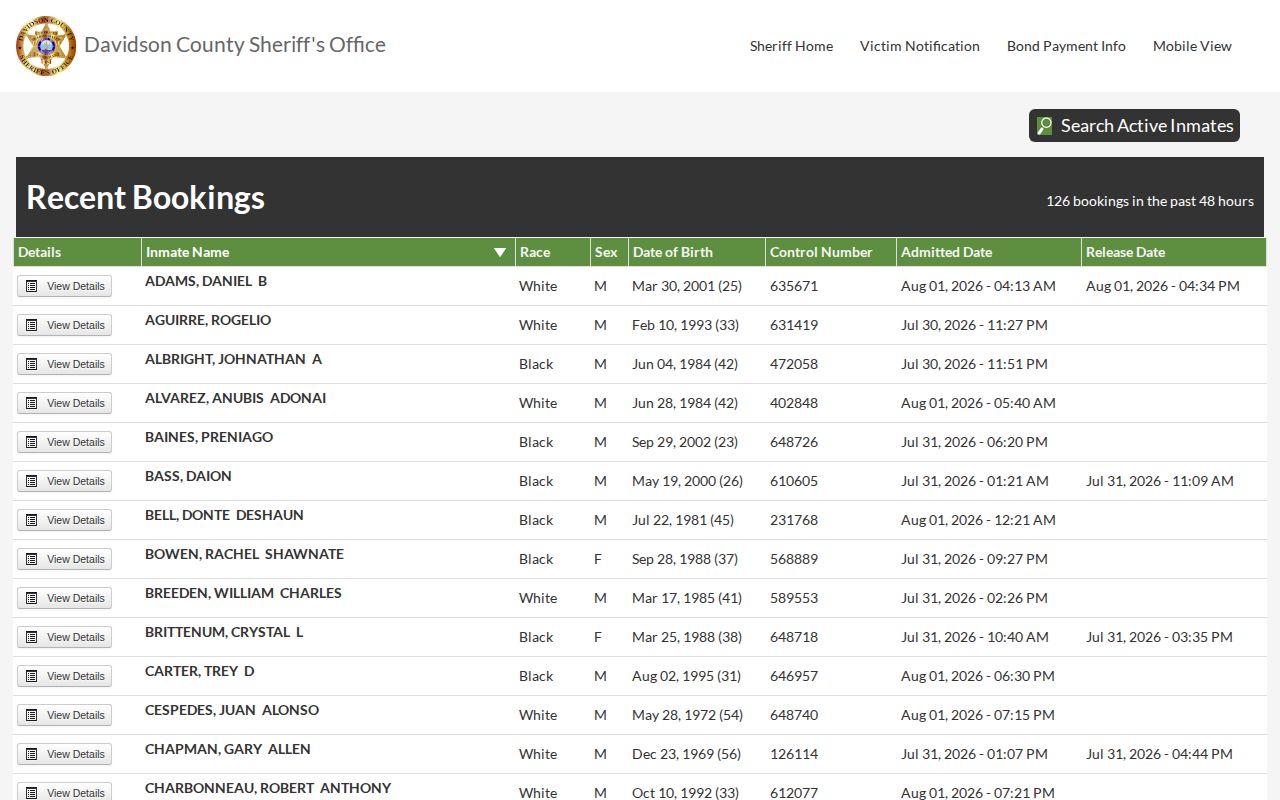
The image makes the limit clear: admission controls inclusion while release appears as one field.
Davidson Weekend Release Coverage
A three-day period often crosses a weekend or holiday. DCSO publishes no fixed release time and no refresh schedule for the recent page. Intake and Pretrial Screening work around the clock, so releases may be processed outside records-center hours. A web row may update after the custody action.
The physical records center operates 7:00 a.m. to 3:30 p.m. Monday through Friday at 610 W Due West Avenue in Madison. The Offender Information Center remains available 24/7. Use the phone line for timely confirmation, then obtain release papers for a lasting record.
Davidson Release Search Fallbacks
For one person, call DCSO with the full name, birth date, approximate dates, and control number. Ask whether release was to the community or another custodian. Absence from the rolling page may reflect its cutoff rather than a missing record.
TN SAVIN can notify a registered user of a known person's custody change. It is not a historical three-day report. TDOC FOIL applies after a Tennessee felony transfer or for state supervision. BOP and ICE locators cover only their systems. The Davidson 24-hour release workflow is better for today's populated timestamps.
Confirm Davidson Release Disposition
A release date establishes the end of one DCSO booking. Bond or recognizance can end jail custody while the case stays open. A transfer ends DCSO custody but continues confinement. Time served or sentence expiration can still be followed by another hold or supervision.
| Result | Next check |
|---|---|
| Bond context | Criminal Court Clerk docket and bond conditions. |
| State transfer | TDOC FOIL by name or TOMIS number. |
| Federal transfer | BOP locator, federal docket, or USMS. |
| Immigration transfer | ICE locator and ERO inquiry. |
Use custodian-specific wording. “DCSO recorded release” is accurate. A claim of unconditional freedom requires checks for transfers, holds, and supervision.
Davidson 48-Hour Window Quirk
The page has no documented retention guarantee beyond its admission rule. It can overrepresent quick releases and miss longer stays ending in the same calendar range. Two checks made a day apart may show different sets without any error.
For a reproducible query, identify the date range before contacting DCSO. Request all matching release episodes and say whether transfer dispositions should remain. Keep transfers because they explain why someone left the Davidson roster but appears elsewhere.
Note: A missing online row is not proof no Davidson release occurred; the admission rule may exclude the episode.
Davidson Release Dates and Courts
The Criminal Court Clerk reporting system reflects filed documents and docket entries. It can explain whether release followed bond, dismissal, a sentence ruling, or another order. DCSO warns that bond figures can change, so the clerk is the source for current court status.
Dates may differ without conflict. A judge can issue an order before DCSO finishes administrative release. The jail timestamp closes custody, while the docket records the court event. Compare both and request the episode when destination is unclear.
Scope Davidson Release Requests
A useful three-day request should define the period and the record fields. State the beginning and ending date and time in Nashville local time. Ask whether the result includes community releases, transfers, deaths, and other dispositions that close a DCSO episode. Without that detail, two requesters could receive different counts while using the same phrase. DCSO records transactions by booking episode, not a universal statement about where each person went next.
Ask for name, control number or OCA, admission date, release date and time, releasing facility, and release disposition when available. If the purpose is to verify one person, request that episode instead of a countywide list. A narrow request reduces identity errors and makes it easier to compare the response with the clerk docket.
Match Davidson Release Identities
Names alone are weak identifiers. The public table also supplies date of birth, race, sex, and control number. Use several fields together, while treating the control number as the best bridge between the list, Details, a telephone question, and a written request. Never assume two records belong to one person merely because the names match.
Details can add arrest booking date, final booking date, facility, charges, and sentencing information. Those facts help connect the jail episode to the right court file. The court case number may not be displayed as the same identifier, so compare dates and charges with care. When doubt remains, ask DCSO or the clerk to confirm which booking and case correspond.
Davidson Releases After Roll-Off
Once a qualifying admission rolls off Recent Bookings, the public page is not a promised archive. DCSO's records office becomes the county source. The online request form asks for requester contact details, inmate name, OCA when known, and a description. “Incarceration Date (Release Papers)” is the most precise listed category for a release document.
For court context, the Criminal Court Clerk public system reflects filed documents and docket entries. Circuit Court's CaseLink covers its own case universe. Use the correct clerk instead of treating the jail detail as final disposition. A DCSO release timestamp may follow the judge's order because booking staff still must finish administrative processing.
Note: Keep the response date with a three-day release report because later corrections or added court documents can change linked records.
Document Davidson Three-Day Searches
Record the exact period, source, and observation time. If DCSO supplies a range response, retain its definition of release and any excluded records. That context lets another reader understand why an official three-day result differs from the live 48-hour admission page.
Review Davidson Range Responses
When DCSO returns a three-day record, compare each release date with the requested endpoints. Check whether a row represents community release, transfer, death, or another administrative closure. A total that mixes those events should be described as DCSO booking episodes closed during the period, not as a count of people who returned home.
Look for duplicate names tied to separate control numbers. One person can have more than one episode, while two people can share a name. Note any field DCSO withheld or did not maintain. If the response lacks disposition, follow up on the specific control number instead of guessing from the charge or facility.